














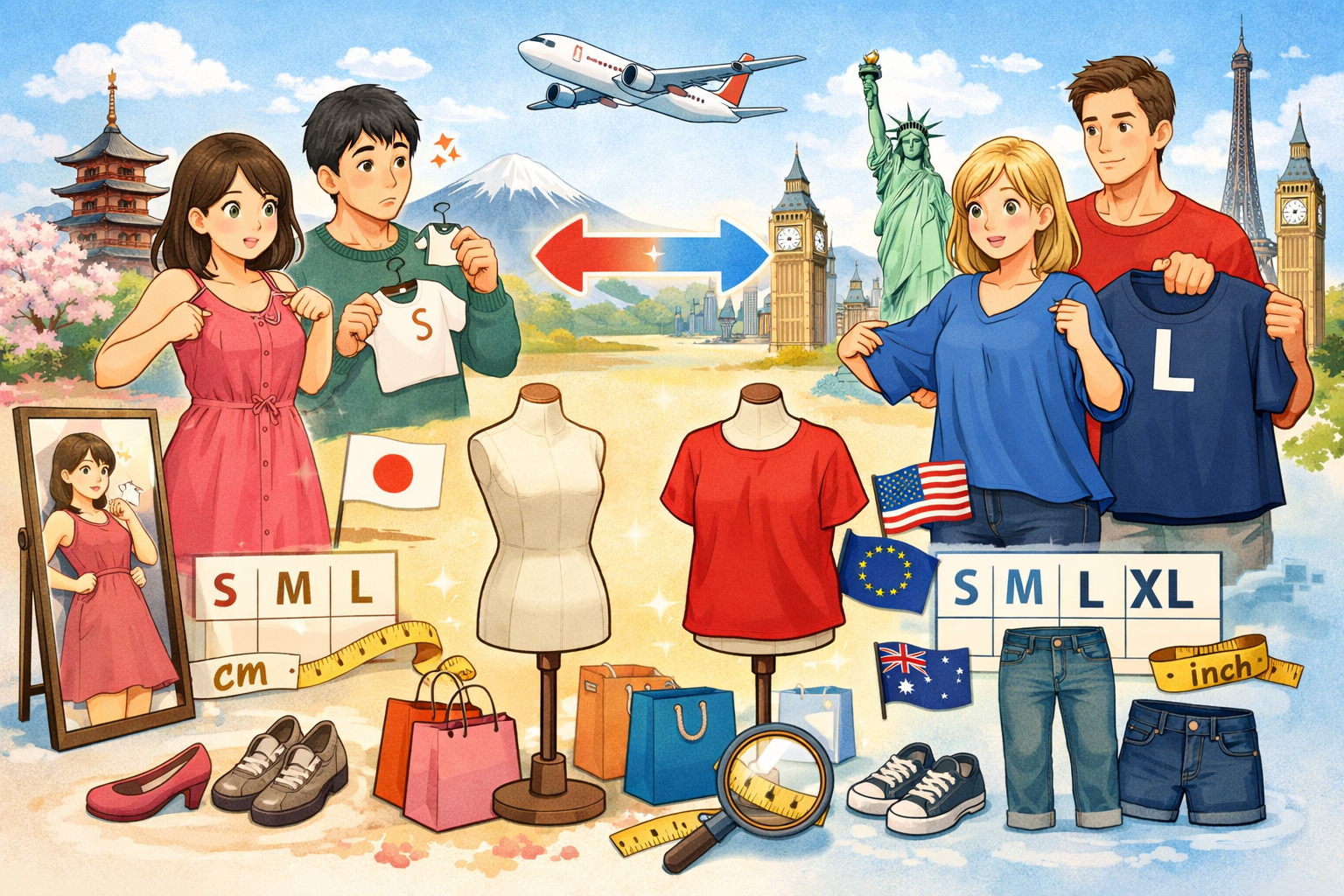
Finding a great piece of clothing from an international brand online or during a trip is always exciting. However, many people experience the disappointment of ordering their usual size, only to find that it doesn’t fit at all.
In fact, even when the size label is exactly the same, the actual dimensions of Japanese and international clothing differ significantly. With online shopping becoming a regular part of our lives, understanding how these sizing systems work is essential for a stress-free shopping experience.
This guide breaks down the differences between Japanese and overseas clothing and shoe sizes using specific numerical examples, offering straightforward tips to help you get the perfect fit every time.
Sizing Characteristics of Japanese Clothing
Japanese clothing brands generally design their garments for smaller, more compact body types. Because of this, the overall silhouette tends to be more fitted and tailored closer to the body.
In Japan, sizes are commonly indicated by letters like “S, M, and L,” or by a traditional numbering system called go (e.g., 7-go, 9-go, 11-go) for women’s apparel. As a general benchmark, a 9-go label corresponds to a standard medium (M), while an 11-go represents a slightly more relaxed large (L).
For instance, consider a standard Japanese brand’s medium (M) t-shirt (based on typical unisex or men’s standards). It is often designed with the following approximate measurements:
- Chest: 88 cm
- Waist: 74 cm
- Length: 65 cm
- Shoulder Width: 40 cm
Additionally, because the culture of trying on clothes in-store is deeply rooted in Japan, retail spaces are highly optimized for shoppers to test the fit before making a purchase.
Sizing Characteristics of International Clothing
Overseas brands—particularly those from the United States and Europe—cater to individuals with generally larger physiques. Consequently, their garments feature a more relaxed silhouette and a much roomier cut.
Sizing conventions vary by region. Instead of just letters, you will frequently see European numbers like “38” or “40,” or measurements listed in inches. This means that a garment labeled “M” from an international brand will consistently run one or two sizes larger than a Japanese “M.”
Take an American brand’s medium (M) t-shirt as an example. The actual dimensions often look like this:
- Chest: 96 cm
- Waist: 82 cm
- Length: 70 cm
- Shoulder Width: 42 cm
When you compare these numbers to the Japanese medium, the international version is roughly 8 cm larger in both the chest and waist. If you shop with international brands using your usual domestic size habits, you run a high risk of ending up with a garment that is far too baggy to wear.
Comparing the Numbers: How to Read Size Charts
To ensure a successful purchase, look beyond the simple letter on the tag. Always scroll down to the product details page and verify the “actual garment dimensions” (the real measurements of the finished item).
Let’s look at a side-by-side numerical comparison using the t-shirt examples from earlier:
| Measurement Area | Japanese Brand (Size M) | US Brand (Size M) | Difference |
| Chest | 88 cm | 96 cm | +8 cm |
| Waist | 74 cm | 82 cm | +8 cm |
| Length | 65 cm | 70 cm | +5 cm |
| Shoulder Width | 40 cm | 42 cm | +2 cm |
With an 8 cm gap in the chest area, the difference in fit is substantial. If you typically wear a Japanese medium (or a women’s 9-go), opting for an international Size S will generally give you the closest equivalent fit.
Keep in mind that dimensions can still vary within the same country or brand depending on the intended style of the garment—such as a slim-fit versus an oversized look. A jacket’s shoulder width might be 46 cm in one brand and 48 cm in another, so making a habit of checking the specific size chart for each item is highly recommended.
Crucial Differences in Shoe Sizing
The variance doesn’t stop at clothing; shoe sizes require careful attention as well. While Japan uses centimeters (cm), overseas markets rely on completely different numbering systems. Furthermore, even if a shoe is built for a specific foot length, the width and instep height can vary by region.
Women’s Shoe Sizes
A Japanese women’s size 24 cm roughly translates to a US Size 7. However, the actual internal length of an international size 7 shoe is often closer to 24.5 cm. This means the shoe may feel slightly longer in the toe box but narrower across the sides compared to a standard Japanese shoe.
Men’s Shoe Sizes
A Japanese men’s size 26 cm generally corresponds to a US Size 8. While a US 8 targets a 26 cm foot length, international footwear is frequently built on narrower lasts. Because many Japanese individuals have wider feet or higher insteps, these shoes can feel uncomfortably tight around the sides.
When buying shoes from abroad, checking for width indicators (like “D” for standard or “E” for wide) alongside the length will save you a lot of trouble.
Practical Tips for Finding Your Perfect Fit
Here are three practical strategies to keep in mind so you can shop international brands with confidence:
- Match the Size to Your Desired Style
If you prefer a sharp, tailored silhouette, choose one size smaller than your usual domestic size (e.g., move from a Japanese M to an international S). If you love a modern, relaxed look, ordering your usual size will naturally give you that effortless, slightly oversized drape. - Prioritize Retailers with Flexible Return Policies
Even with careful measuring, fabric stretch and unique cuts can occasionally cause fit issues. When ordering online, protect yourself by choosing websites that offer customer-friendly policies, such as free size exchanges or returns within 30 days. - Visit a Local Physical Store First
If the international brand has a brick-and-mortar store near you, taking a few minutes to try on their items in person is the best approach. Once you understand how that specific brand’s sizing maps to your body, you can confidently order from their online store in the future.
Conclusion
The core difference between Japanese and international clothing sizes stems from the average body types these garments are designed to fit. A standard medium from the US or Europe can be more than 8 cm larger in the chest and length than a Japanese medium.
To avoid sizing mistakes, focus on the actual physical measurements—like chest and shoulder width—rather than relying solely on the letter on the tag. By aiming for a size down or sticking to stores with flexible return policies, you can easily broaden your wardrobe with beautiful international styles that fit you beautifully.

コメント